- Home
- Government
- Department of Public Works
- Septic Information for Homeowners
Septic Information for Homeowners
Homes that are not connected to a public sewer most likely have a septic system for household wastewater. Septic systems vary from household to household. Varying factors include the size of the household it supports, soil type, slope of the property, lot size, proximity to bodies of water, local regulations and more. Although there's many types of septic systems used, all community members are encouraged to keep their system properly maintained.
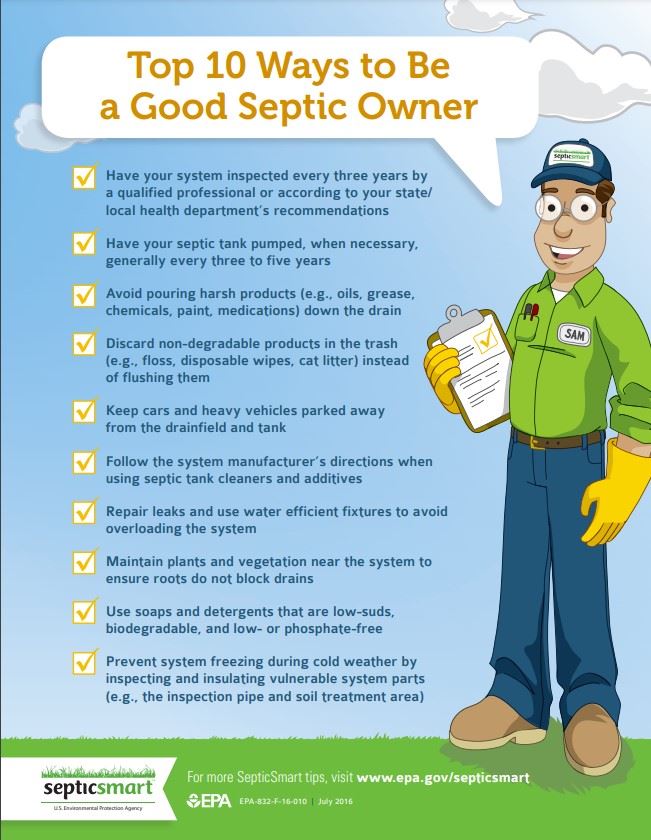
Top 10 Ways to Be a Good Septic Owner 
- Have your system inspected every three years by a qualified professional or according to your state/local health department’s recommendations
- Have your septic tank pumped, when necessary, generally every three to five years
- Avoid pouring harsh products (e.g., oils, grease, chemicals, paint, medications) down the drain
- Discard non-degradable products in the trash (e.g., floss, disposable wipes, cat litter) instead of flushing them
- Keep cars and heavy vehicles parked away from the drainfield and tank
- Follow the system manufacturer’s directions when using septic tank cleaners and additives
- Repair leaks and use water efficient fixtures to avoid overloading the system
- Maintain plants and vegetation near the system to ensure roots do not block drains
- Use soaps and detergents that are low-suds, biodegradable, and low- or phosphate-free
- Prevent system freezing during cold weather by inspecting and insulating vulnerable system parts (e.g., the inspection pipe and soil treatment area)
The Do’s and Don’ts of Your Septic System 
Protect It and Inspect It:
Do:
- Have your system inspected (in general) every three years by a licensed contractor and have the tank pumped, when necessary, generally every three to five years.
Think at the Sink:
Do:
- Eliminate or limit the use of a garbage disposal.
- Properly dispose of coffee grounds & food.
- Put grease in a container to harden before discarding in the trash.
Don’t:
- Pour cooking grease or oil down the sink or toilet.
- Rinse coffee grounds into the sink.
- Pour household chemicals down the sink or flush them.
Don’t Overload the Commode:
Do:
- Dispose of the items below in the trash can!
Don’t:
- Flush non-degradable products or chemicals, such as feminine hygiene products, condoms, dental floss, diapers, cigarette butts, cat litter, paper towels, pharmaceuticals.
Shield Your Field:
Do:
- Consult a septic service professional to advise you of the proper distance for planting trees and shrubs, depending on your septic tank location.
Don’t:
- Park or drive on your drainfield. The weight can damage the drain lines.
- Plant trees or shrubs too close to your drainfield, roots can grow into your system and clog it.
Don’t Strain Your Drain:
Do:
- Stagger the use of water-generating appliances. This can be helpful especially if your system has not been pumped in a long time.
- Become more water efficient by fixing plumbing leaks and consider installing bathroom and kitchen faucet aerators and water-efficient products.
Don’t
- Concentrate your water use by using your dishwasher, shower, washing machine, and toilet at the same time. All that extra water can really strain your septic system.